

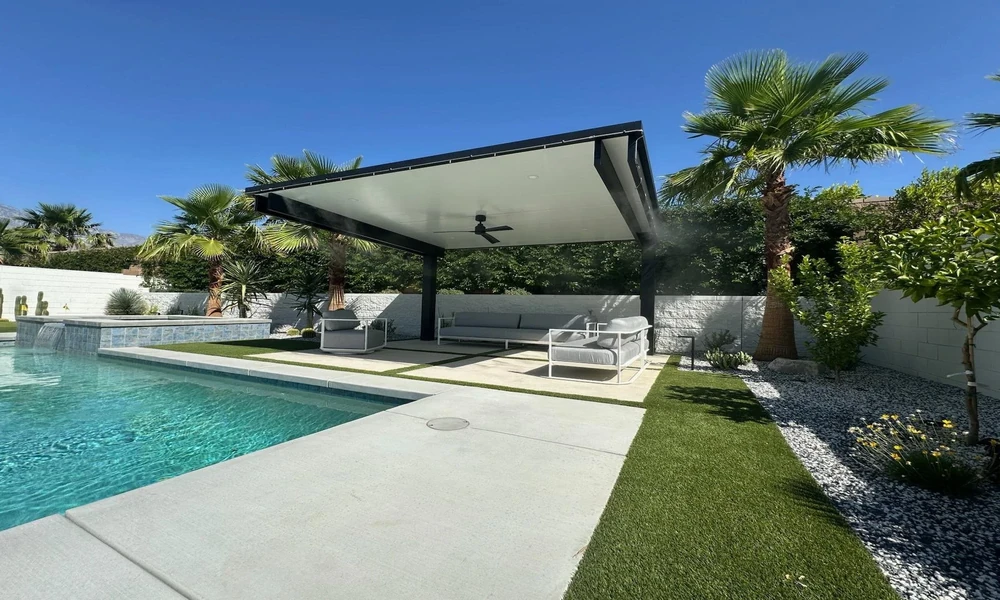

Your patio hits 150 degrees on an August afternoon. Not the air, the concrete. I have watched a cheap fabric awning on a Arcadia porch turn the color of weak coffee in fourteen months, and the owner paid twice: once for the awning, once for the replacement. That is the whole argument in one yard.
Here is the short version. Any shade beats no shade. After a few summers, metal shade outlives fabric. Fabric earns its place only when you need it to pack away, and in this valley that is a narrower need than most homeowners think. Weighing this for your own house comes down to three questions: how much direct sun the west face takes, how much wind the frame must survive, and how often you actually want to fold something up. You can find professional awning installation in Phoenix that handles both fabric and metal, and the good crews will tell you which one your yard wants instead of pushing whichever they stock deeper.
What most people miss is that the Phoenix sun does not care about your taste. It works on everything you own at the same rate regardless of what looks nicer.
What Phoenix Sunlight Actually Does to Fabric
Ultraviolet light breaks chemical bonds in dye and polymer. Every material ages in the sun, just at wildly different speeds. That is basic materials science, not a sales pitch, and the National Institute of Standards and Technology studies how materials degrade under ultraviolet exposure.
So why does fabric lose the race here? Three reasons stack up. First, our ultraviolet index sits higher for more of the year than in nearly any other American metro. Second, monsoon dust grinds into woven thread, so every breeze sandpapers the weave a little. Third, heat alone ages acrylic and polyester, even on the shaded side.
None of that means fabric is junk. Good solution-dyed acrylic holds color far better than the bargain stuff, and it stays cooler to the touch than metal, which matters if you brush against it. My own stance: buy quality fabric or buy metal. The middle tier is where money goes to die. I have watched homeowners replace a mid-range awning twice in eight years, spending more than a welded frame would have cost on day one.
Metal Covers, Pergolas, and Lattice: Reading the Three Options
Now the metal side, which is not one product but a family.
A solid pan cover is a fixed roof over part of your patio, usually steel or aluminum panels spanning between posts. It blocks nearly all direct sun and rain, and it does the most for a west-facing wall. Lattice pergolas trade some shade for airflow and a softer look, and the open grid throws patterned light that photograph beautifully at dusk. Welded frame pergolas land between the two, with rafter spacing you choose based on how much sun you want to cut.
Here is the rough hierarchy for a Phoenix yard. West-facing, unshaded patio used daily: solid pan. North or east exposure used on weekend mornings: lattice or an open pergola. Attached to a house with an HOA that limits roof structure: retractable fabric, mounted under the eave. HOAs do approve shade structures routinely, but they want drawings, colors, and often a screen that hides the frame from the street.
Powder-coated aluminum resists rust and accepts color that holds for years. Steel will span wider distances, and it needs more attention at the welds over time. Neither one is a forever fix, but both outlast a fabric skin by a wide margin.
Fire Code and the One Detail You Can’t Skip
Wildfire exposure is a real budget line in the outer reaches of the Valley. In areas that fall in wildfire hazard zones, outdoor structures have to meet specific ignition-resistance rules, and the U.S. Department of Energy tracks how exterior shade shapes home cooling loads and energy use.
A breathable sun screen actually resists ember intrusion better than a woven cover with material behind it, because wind passes through instead of hitting a wall. That is the opposite of what people assume. Metal panels need the same defensible-space clearance you give your house either way, so nothing sitting underneath becomes fuel.
Two practical numbers to carry into any quote: shade on the west glass cuts afternoon cooling load more than any other single change, and a screen with a tighter weave blocks more heat and more view in the same measure. Pick your tradeoff before you pick a color.
A 20-Minute Walkthrough You Can Do This Weekend
Stand in your yard with a phone. Note when the sun actually hits the patio, because it is rarely as early as you think. Then check:
- Measure the length of the west or southwest wall that takes direct afternoon sun.
- Watch where the sun lands from 1 p.m. to 5 p.m. and mark the hot zone in chalk.
- Check your HOA packet for rules on attached structures, roof height, and exterior colors.
- Get two quotes that specify panel material, frame finish, and post footing depth.
- Ask each crew what happens to the warranty when the fabric or finish fades, not if it fails.
Ask one more question at the end of every visit: who comes back when this fades. The answer separates a real outfit from a truck with a phone number.
For a broader view of how outdoor shade and heat interact across the region, the University of Arizona studies heat and sun exposure in desert communities.
Materials and Money: The Bottom Line
| Option | Sun Block | Typical Service Life Here | Best Fit |
|---|---|---|---|
| Solution-dyed acrylic awning | High when extended | 5 to 10 years | Renters, HOA limits, folding shade |
| Metal solid pan cover | Highest | 15 to 25 years | West-facing, daily use |
| Lattice or open pergola | Moderate | 15 to 25 years | Look and airflow over pure shade |
| Exterior solar screen | Good, filtered | 7 to 12 years | Cutting glare without darkening a room |
Two traps show up in nearly every quote I see. Under-sizing the posts so the structure sways in a monsoon gust, and choosing fabric because it was the only option priced on the spot. Slow down. A shade quote is a ten to fifteen year decision, and the cheap line item rarely stays cheap.
If you want the fastest single upgrade, a retractable exterior screen costs a fraction of a covered structure and cuts afternoon glare in one weekend. If you want the one that changes how you actually use the yard, order the metal cover and stop thinking about it.
Walk your patio at 3 p.m. tomorrow and stand in the hottest spot. Then decide which way you want that spot to feel next July.